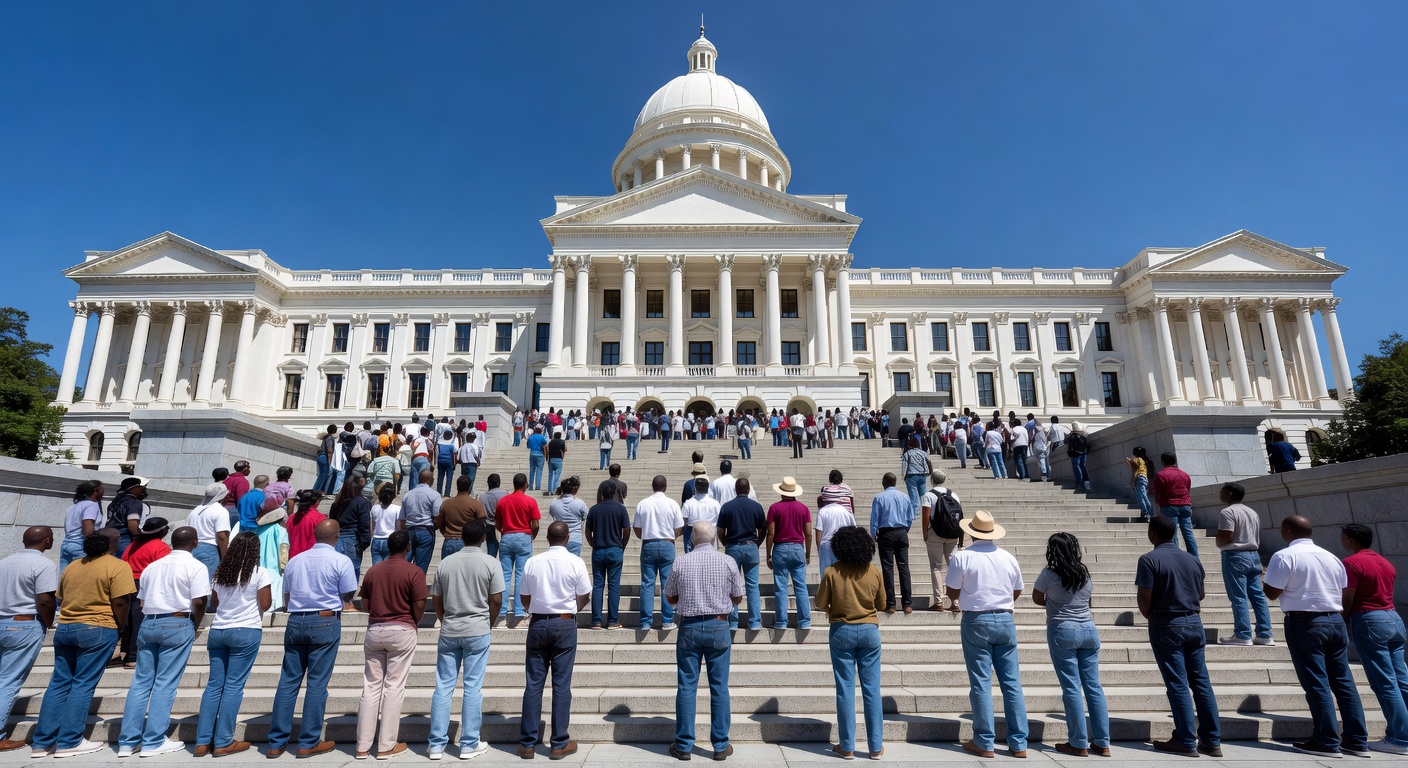
Thousands rallied on Saturday, May 16, 2026, in Montgomery, Alabama, to defend Black political representation amid redistricting efforts following a U.S. Supreme Court ruling that weakened the Voting Rights Act. The event began in Selma at the site of the 1965 Bloody Sunday march and ended at the Alabama State Capitol steps where Rev. Martin Luther King Jr. spoke that same year. Organizers framed the gathering as a direct response to new maps that could eliminate majority-Black districts in the state.
Route retraces 1965 civil rights path
Participants started in Selma before boarding buses for the 50-mile trip to Montgomery. The route deliberately followed the path of the historic Selma to Montgomery marches that led to passage of the Voting Rights Act. Speakers repeatedly invoked that history to argue that recent court decisions have rolled back protections won six decades ago.
By the time the crowd reached the Capitol, several thousand people had assembled under sunny skies. Local clergy led prayers and chants before the program of speeches began. The setting itself carried symbolic weight because the same steps hosted King’s final address in the city during the 1965 campaign.
Speakers tie ruling to immediate district threat
U.S. Sen. Cory Booker, redistricting plaintiffs Shalela Dowdy and Evan Milligan, and Rep. Shomari Figures addressed the crowd. Each speaker highlighted Alabama’s 2nd Congressional District as the clearest example of what is now at risk. A 2023 federal court order had created a majority-Black district there, but a revised map approved after the Supreme Court decision opens the seat to potential Republican reclamation.
The new map takes effect for special primaries scheduled for August 11, 2026. Figures told the audience that losing the district would reduce Black voting power in Congress at a time when the state’s Black population continues to grow. Dowdy and Milligan, both plaintiffs in the original lawsuit, described the legal setbacks they now face in defending the lines they helped draw.
